How to Play Candy Pipeline: Tips and Strategies for Beginners

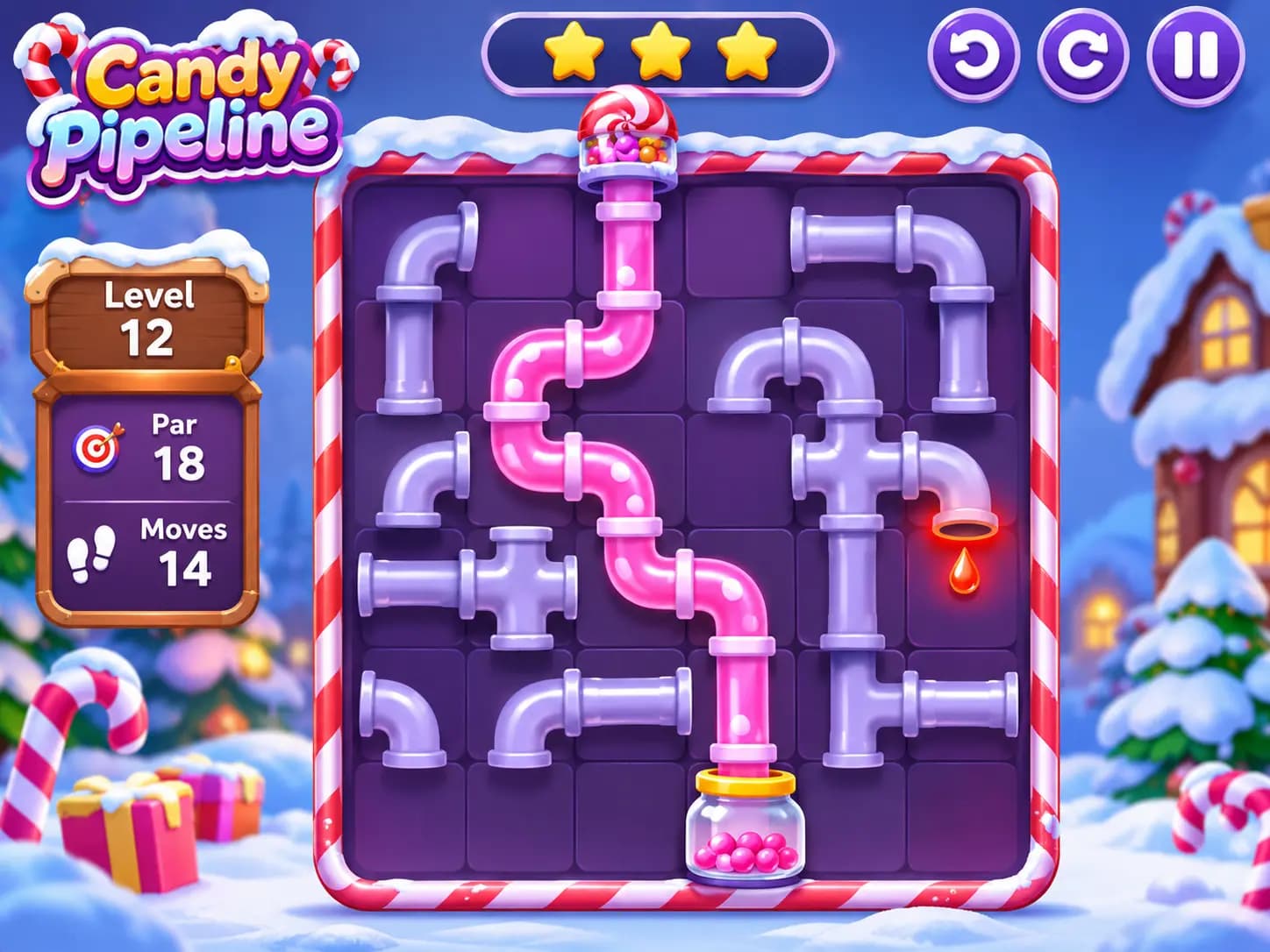
Turn the pipes until the candy reaches the jar and every opening is sealed. A loose end on a pipe the candy never touches still fails the level.
Table of Contents
Santa pours candy in at the top. The jar waits at the bottom. Every pipe on the board has been twisted out of a network that used to be sealed, and a level is you turning those pipes back until the candy can travel the whole way down.
You can see how far you have got. A pipe the candy has reached glows pink. A pipe it has not reached stays dull purple. A red drip marks an opening where the candy is leaking out. Pink means the path above that pipe is already right. Purple means you have not earned that pipe yet. A drip means the pipe you are looking at is facing the wrong way.
The jar filling is not the end. The level ends when the jar has candy and every opening on the board meets another pipe. One loose end is enough to hold the level, and it can sit on a pipe the candy never flows through. A purple corner, ignored because the main path looks finished, is a common reason a pink line to the jar still does not clear.
There are 40 boards. Each one is generated, then kept. Come back to level 12 tomorrow and the pipes are twisted the same way. The board started as a finished network with no leaks, and then the pipes were turned, so a way back exists. You are restoring that network, not designing a new route.
Down the pink, one pipe at a time
Begin at the inlet. Turn the first pipe until the candy enters it and the pipe goes pink. The next dull pipe under that pink is the one to turn. A pipe three rows lower can wait. If you twist it now, you cannot see whether it helped, because the candy has not arrived to tell you.
When a red drip appears, that opening is the mistake. Turn the pipe until the drip goes and the pink moves forward. On the outer edge, an opening that points off the grid is always a leak. It has no neighbor out there to meet. Side pipes and corner pipes have fewer faces that can be correct, so they settle quickly. Do them while the board is still small enough to see the rim, and again at the end of a large board, as a last look.
A T-junction is the pipe that starts to matter from the middle levels. It has three openings. Two of them have to meet neighbors. The third has to meet a neighbor as well, or it drips. Turning a T does not only aim the flow downward. It also swings the side opening onto a new pipe, or off the board. If the candy goes pink and a side branch of the same T starts to drip, that one pipe is both right and wrong. Turn it again, or turn the neighbor it is trying to meet.
A crossroads is the pipe to leave alone. It looks the same after a quarter turn, because every side is an opening. Spending a move on it does not change the leaks around it. Turn the pipes that join the crossroads. Those are the ones that can face a wall, a gap, or the wrong neighbor.
A click, a right-click, and Undo
A click turns a pipe one quarter clockwise and counts as one move. On a phone, a tap does that same clockwise turn. The screen has no anticlockwise tap.
With a mouse, a right-click turns the pipe one quarter the other way, and that right-click counts as one move too. Three clockwise clicks would walk a pipe the long way around to the face you wanted. One right-click arrives there immediately. On most levels that saved pair of moves is the difference between three stars and two.
U or Z undoes the last clockwise turn and takes that turn off the move count. On a phone, Undo is the only way back. A tap cannot spin the other direction, so a wrong tap should be undone before the next one, while it is still the last clockwise turn.
A right-click is not what U removes. To put a right-clicked pipe back, left-click it. That left-click is a new move. So a mouse player who right-clicks the wrong pipe has spent one, and spends another to repair it. A phone player who taps wrong and immediately presses Undo spends nothing.
R restarts the level from the same twisted pipes. The scramble does not change. Esc leaves the board and goes back to the level list.
What the par is asking for
Every level shows a par. That number is how many clockwise quarter-turns it takes to put the pipes back as they were before they were scrambled. It is not a timer. It is a turn budget.
Three stars means you finished at the par, or no more than about a fifth over it. A par of 10 is a three-star clear at 12 turns or fewer. Two stars allows a wider miss, up to about 85 percent over the par, so that same par of 10 still earns two stars around 18 turns. More turns than that, once the jar is full and nothing drips, is one star. You did pass. You did not pass tightly.
Undo matters to the stars because a clockwise turn you take back leaves the count as well. A mis-click, undone at once, does not have to cost a star. Three left clicks used where one right-click would do it, on a mouse, will. Those two extra turns sit on the par even though the pipe ends on the same face.
From a 4 by 5 to a 7 by 7
Levels 1 to 8 are 4 by 5. The path is short, the rim is easy to see, and this is the place to learn that pink confirms the pipe above it. Clearing these by chasing drips, without a plan, still works. It will not work the same way on a 7 by 7.
Levels 9 to 17 are 5 by 6. Levels 18 to 28 are 6 by 6, and the T-junctions become ordinary. A pipe can need three neighbors at once. Turn it until all three openings meet a pipe, not until the candy merely moves.
Levels 29 to 40 are 7 by 7, thick with T-junctions and crossroads. The order that still holds is the early one, just longer. Pink from the top. Edges and corners next, because an opening off the board can never be sealed by hoping. Crossroads left unturned. Then a last walk for any purple pipe with a free end. The candy does not have to enter that pipe. The opening still has to meet something.
Restarting one of these with R puts the same twists back. If a 7 by 7 went bad at turn 30, you are not looking at a new puzzle. You are looking at the same inlet, and the pink can be built again without the turns that wandered into the crossroads.
A jar that fills and does not clear
Two misses account for most one-star, or failed, boards.
The first is a path that looks done. Candy runs pink to the jar, and a pipe off to the side, never touched by the flow, still has an opening on empty space. That drip, or that bare end, is the level. Turn it into a neighbor. Then the jar counts.
The second is a par spent on pipes that did not need it. A crossroads takes a click and stays a crossroads. Three clockwise clicks, where a right-click was one, push a mouse game over the fifth-extra line and out of three stars. On a phone the same leak in the count is a wrong tap that was not undone.
Open level 1. Turn the inlet until the first pipe goes pink, and follow that color down. When the jar has candy, look around the rim for an opening that still points off the board. That look is the level, not a bonus.
Fill Water Tank is the other flow puzzle on Pokky Game. There the path is a line you draw, and the water only counts if it drips through the tank opening.
More of the collection is on Pokky Game.
Written by

Navinkumar Ahir
The studio
Navinkumar Ahir is a content creator and part of the team behind Pokky Game, a free online gaming platform featuring a wide variety of puzzle, arcade, racing, shooting, and sports games. He focuses on creating helpful gaming guides, tips, and strategies based on real gameplay, helping players discover new games, learn how to play, and overcome challenging levels. His goal is to make gaming simple, enjoyable, and accessible to everyone, with no downloads or account required.