How to Play Carrom: Tips and Strategies for Beginners

Learn how to play Carrom online, understand the rules, choose your colour, cover the queen and use simple shooting techniques to improve your game.
Table of Contents
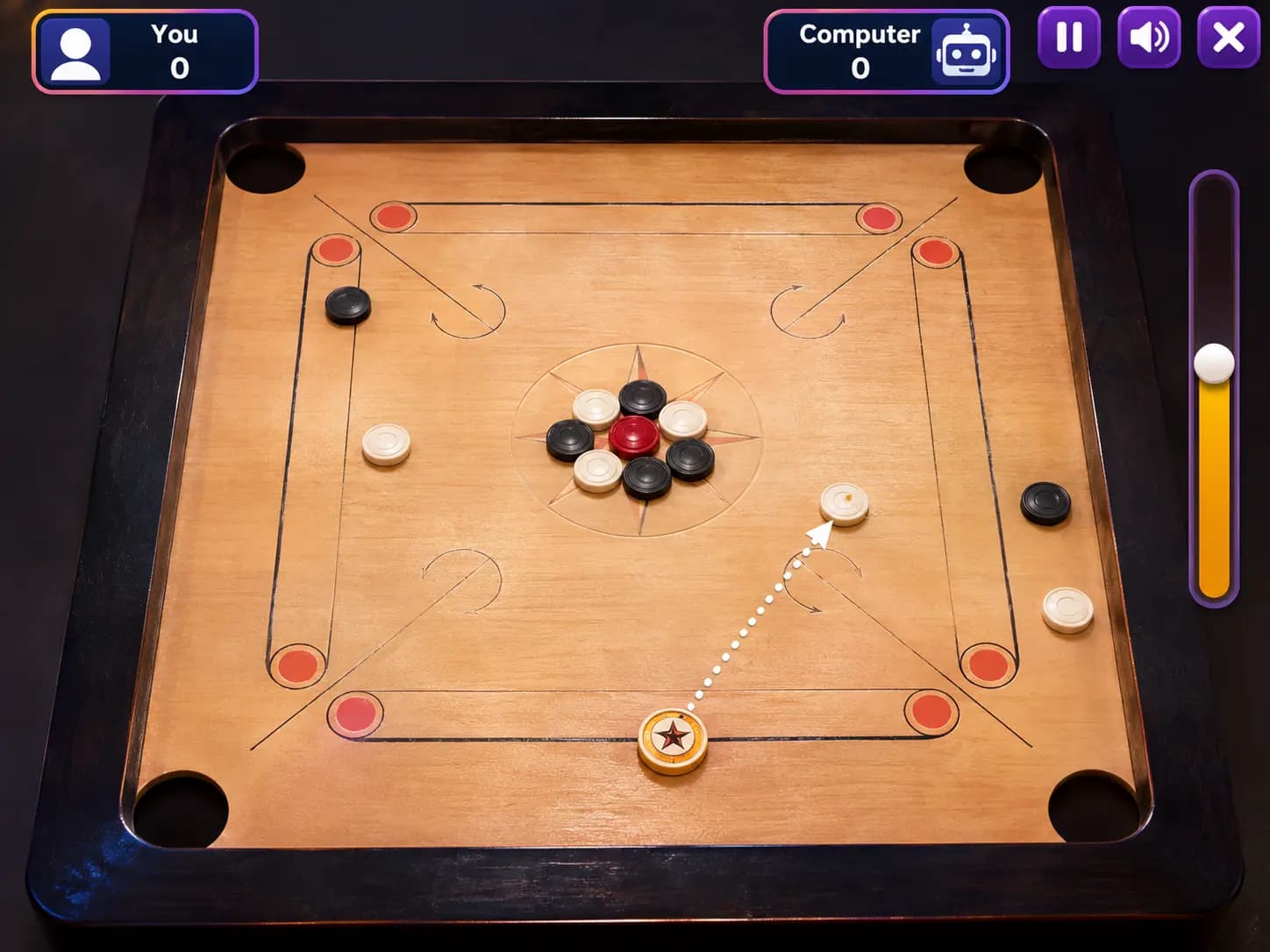
Nineteen pieces sit on the board. Nine are white, nine are black, and the red queen is in the middle, with six men around her and twelve more outside that ring. The holes are the four corners. Nobody owns a colour yet. The striker starts on your own base line, and every stroke has to be played from there.
The first man chooses the colour
Open Carrom.
Drag along your line to set where the striker sits. The left and right arrows nudge it without a drag. Then drag away from the striker, toward the man you want. Further is harder. The power bar shows what you have wound up. Let go, and that is the stroke. U takes the last stroke back.
The opening ring is the six men around the queen. Hit that ring from the side, so one man leaves toward a corner and the queen stays where she is. A stroke square into the front of the ring piles those six in the middle, and a man in the middle has no route to a hole. The twelve men outside the ring can go with that side stroke, still toward a corner rather than back into a heap.
The first man that falls decides the frame. That colour is yours for every stroke after this one, and the other colour is your rival's. You do not pick white or black on the opening card. If the first man is white, you are white even if the striker had been aimed at a black.
Sink one of yours and the board stays with you. The next stroke still begins with the striker on your base line. You do not flick from the middle of the table just because a man fell there. Sink nothing, or sink one of theirs, and the stroke passes. The colour does not change when the board passes. It was fixed by that first man.
The queen, on this stroke or the next
The queen is not a tenth man. Pocket her, and she is yours only if a man of your colour follows her. That covering man can fall on the same stroke, or on the next stroke, and on no stroke after that. Miss the cover and she is put back in the middle.
A cover on the same stroke is the queen and one of your men finding holes off one flick. Let go when both of those paths are real. If only the queen is on a path, the next stroke is the cover, and that stroke has one job: send a man of your colour into a hole.
The stroke that fails the cover does not sink one of yours, so the board goes with her return. Sink one of theirs while she is waiting and both things happen together. She goes back to the middle, and they shoot. A man of yours that reaches a cushion and comes back without falling has not covered her either. Take her when one of your men is already near a corner, close enough that the next stroke from the base line can reach it.
The frame ends when all nine of your colour are banked and the queen is settled. Settled means she has been covered, or she is back in the middle and nobody is still due a cover. You do not have to be the player who covered her. Nine of yours, with her fate already decided, is the frame.
Clip the edge
The holes are in the corners, so a man has to travel sideways to reach one. Strike a man full in the face and it leaves along the line of the striker, away from you, which is rarely a corner. Clip the edge and the man leaves sideways, into the corner a face-on stroke was never aimed at.
Picture the striker on your base line and one man with a clear edge toward the near corner. This is a way to read the board, not a frame the game has saved. A moderate drag, let go, and the clipped man takes the corner. The striker stays on the board. That man was yours, so you shoot again, from the base line, at the next man of that colour you can see.
Hold the drag until the bar is full and the same clip scatters the ring. Men that had a path to a hole are now in the middle. If nothing of yours fell, the board is theirs, on a table you opened up. A softer stroke that takes one man and keeps the turn is the stroke that banks a colour. The full bar is the stroke that leaves them a spread board.
Three quarters comes back off the cushion
A man sitting on the side cushion, with no straight line from your base line to a hole, can still be pocketed. Aim at the far cushion. The cushions give back about three quarters of what you put in, so the man comes off that far wall with most of the pace it arrived with, and the return path is the one that finds the corner.
The pace has to be enough to arrive and still come back. A stroke that dies on the far cushion never makes the return. A stroke so hard that the man flies past the corner after the rebound is the same miss, on the way back. The three quarters is the amount you can count on. It is not a reason to wind the bar to the top.
The striker in the hole
The striker is not a man, and a hole does not bank it. Pocket the striker and a man you have already banked is put back on the board. The stroke passes. You are one man further from nine, and they are the ones shooting.
If nothing of yours has been banked yet, there is no man to return. You lose the stroke, and the count of banked men stays where it was. U, used on that stroke, takes the fallen striker back with it. Once the board has passed, the next stroke is theirs, from their own base line.
A friend plays by choosing Two players on the opening card. The board is passed on the same screen. Against the computer there are three strengths. The base line, the colour, and the cover do not change between them.
Dominoes pays the pips left in the other hands when a player is out of tiles.
More of the collection is on Pokky Game.
Written by

Navinkumar Ahir
The studio
Navinkumar Ahir is a content creator and part of the team behind Pokky Game, a free online gaming platform featuring a wide variety of puzzle, arcade, racing, shooting, and sports games. He focuses on creating helpful gaming guides, tips, and strategies based on real gameplay, helping players discover new games, learn how to play, and overcome challenging levels. His goal is to make gaming simple, enjoyable, and accessible to everyone, with no downloads or account required.