How to Play Rubik's Cube: Tips and Strategies for Beginners

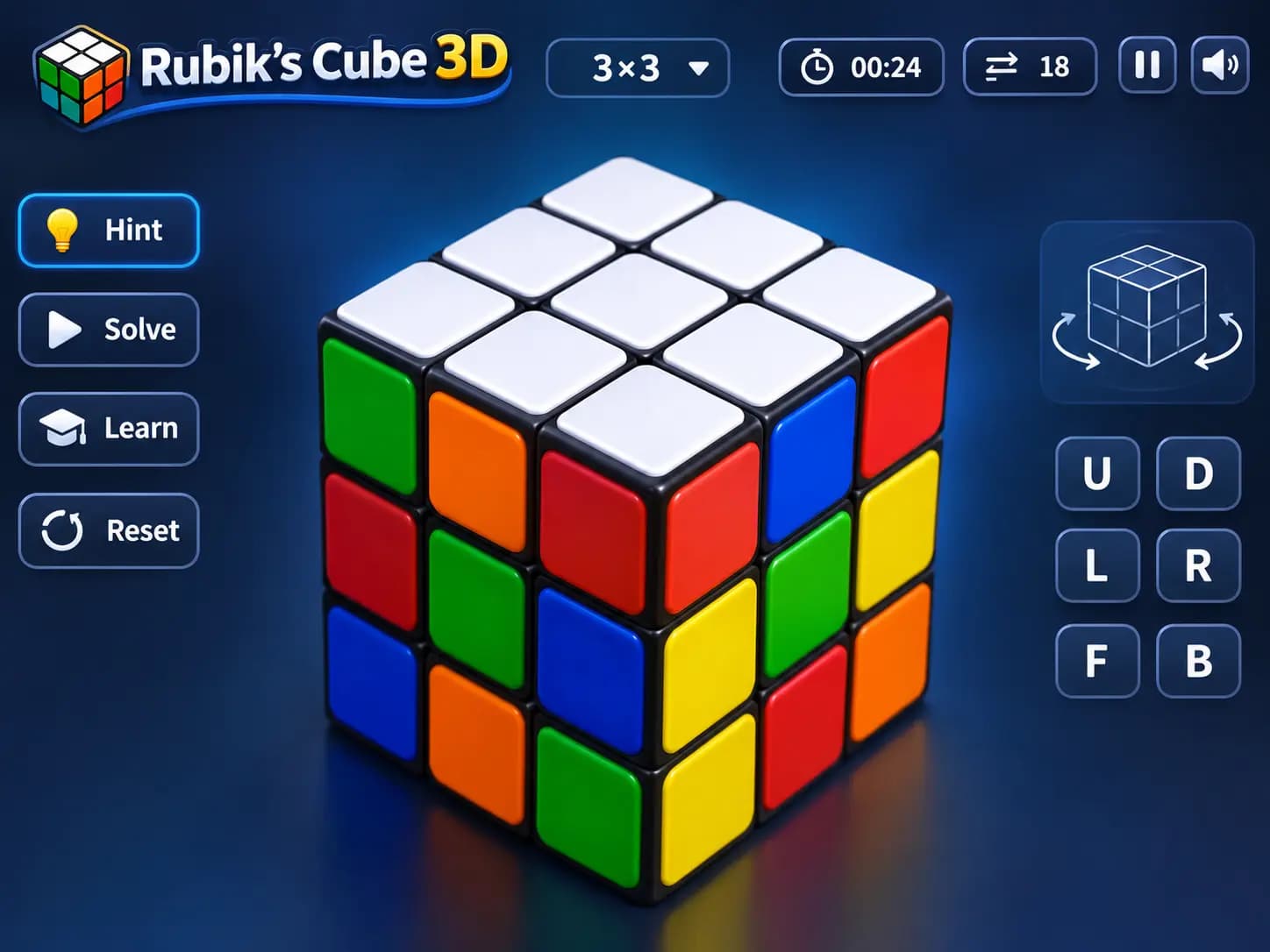
Table of Contents
Four sizes sit on the same cube: a 2×2, a 3×3, a 4×4, and a 5×5. Each one is done when all six faces are a single colour. The scramble you are handed never simply undoes the turn before it, and it never turns the same axis three times in a row, so the mix matches the move count you see.
A clock and a move counter run while you work. Looking at the cube does not start either of them. Only a turn of a layer does. Your quickest solve on each size stays in this browser, on this device, and it does not follow you to another browser or another phone.
A drag on a sticker is a turn
Open Rubik's Cube.
Press on a sticker and pull. The layer that holds that sticker turns the way you pulled. Press beside the cube, on empty space, and the whole cube spins so you can see the back. That spin is free. It is not a move, and it does not start the clock.
Three layer turns, then a spin to check the back, then one more layer turn: the counter has moved four times. The spin in the middle is not one of them. Look at the back before a turn you cannot picture, and the clock stays where the last real turn left it.
On a keyboard the faces are U D L R F B: up, down, left, right, front, back. Shift and the letter turn that face the other way. A middle slice, on the 4×4 and the 5×5, is the layer under the sticker you grabbed. Press a piece in that inner slice and drag. Reset view puts the cube back to the angle it started at. That is a look, not a turn.
If a drag spins the cube when you meant to turn a face, the press landed off the stickers. The next press has to be on a sticker.
A finished face is not a finished layer
Build one face, then the layer behind it. A face that is one colour, with the ring around it still mixed, almost always has to be taken apart. The pieces on the edge of that face also belong to the side faces.
On a white top, the first layer is finished when the white is solid and each side of that layer is a solid bar of its own colour. A white face with green, red, and blue still mixed on the sides of those same pieces is only the face. The next step is still that first layer. The turns that put the side colours right will move white pieces to do it.
Keep one colour on top for the whole solve. Spin the cube when you need a side. Putting a different colour on top means learning the faces again, and that costs more time than the turn you were about to make.
Work in a short run of turns you can undo. Z walks back through your own turns, one at a time, and it stops at the scramble. Four of your turns, then four presses of Z, and you are back at the scramble. A fifth press does not eat into the scramble and finish the cube. If the run left the cube worse, those turns come back, and the only thing you lose is the time the clock already counted.
The seven steps, shown on the cube
Learn opens the layer method in seven steps. The shape of it is one layer, then the band around the middle, then the last layer in four stages. Each step says what it is aiming for, what to look for, and the moves that get there. Leave the last layer alone while the middle band is still broken. The four stages at the end assume that band is already one colour on each side.
Show me plays that step on a cube already set up for the case. Before each turn a curved arrow sits on the layer that is about to move, and it points the way. Watch the arrow. The letters are there to read after the turn, not instead of it.
Hint shows the next turn of this cube
H, or Hint, works out a way to finish the cube in front of you and shows the first turn only. The layer lights in blue, the rest of the cube goes dark, and an arrow beside it points the direction. Nothing is written down. The lit layer is also how you tell which of the seven steps you are on. An arrow still working on the top layer means the middle band can wait.
Ask again after you make that turn and the hint carries on through the same plan. Turn a different layer instead and the old plan is dropped. The next hint is worked out from the cube as it is now.
Show me and Hint are not the same cube. Show me is a fresh cube set up for one step. Hint is the scramble you are already in.
Solve runs backwards
Solve is not a set of forward moves. It unwinds every turn that was made, yours and then the scramble under them, until the cube is as it began. The faces end one colour each because the mix has been played in reverse.
Use it when a cube has got away from you and you want the solved cube back. Use Z when you still mean to finish this scramble yourself. Z stops when it reaches the scramble. Solve does not stop there.
Which size to turn first
Start on the 2×2. It is the same puzzle with the edges taken out, so the corners you learn there are the corners of the 3×3. The 3×3 adds the edge pieces between those corners, and the middle band the seven steps already name.
On the 4×4 and the 5×5, pair the edge pieces before the corners. Two pieces that belong in one edge, sitting apart, block the last layer however tidy the corners look. Join that pair, and then treat it the way the 3×3 treats a single edge. On those larger sizes the centres can stand in for one another. A face counts as finished when it is one colour, not when one particular centre has gone back to a private square.
Jigsaw Puzzle is the other build where a piece has one home. It clicks in when you let it go close to that place.
More of the collection is on Pokky Game.
Written by

Navinkumar Ahir
The studio
Navinkumar Ahir is a content creator and part of the team behind Pokky Game, a free online gaming platform featuring a wide variety of puzzle, arcade, racing, shooting, and sports games. He focuses on creating helpful gaming guides, tips, and strategies based on real gameplay, helping players discover new games, learn how to play, and overcome challenging levels. His goal is to make gaming simple, enjoyable, and accessible to everyone, with no downloads or account required.