How to Play Glaze Glide: Tips and Strategies for Beginners

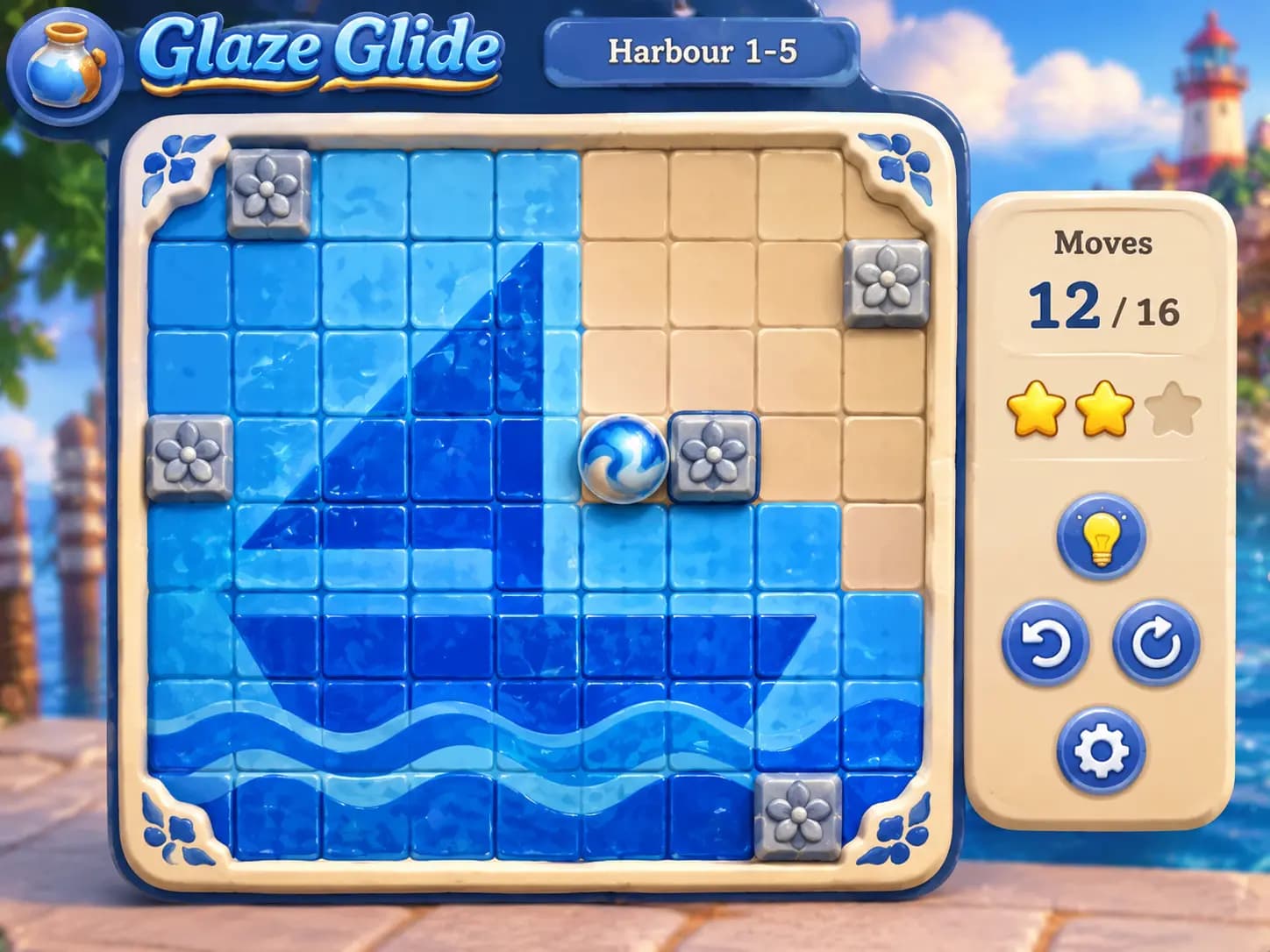
The bead keeps sliding until a stone or the wall stops it. Glaze the corner on the way past. A hint holds the panel at two stars.
Table of Contents
Glaze Glide is 40 pictures on raw clay. A lighthouse, a strawberry, a fox, a hot-air balloon: the picture appears when no raw tile is left. The bead paints every tile it crosses, including the one under it at the start, and a painted tile never blocks a later slide.
It cannot stop where you like. A slide runs until the next cell is bare wall or a raised stone. You cannot get stuck. Every panel can still be finished from any square the bead can rest on, so the number that matters is how many slides you use.
Name the stop, then swipe
Open Glaze Glide.
Swipe, or tap beside the bead. Arrows or W A S D send it the same way. Turn a finger without lifting it and the next slide starts at once, which is how two stops you have already named can be played in one gesture. M switches the sound.
Harbour is stones and the edge of the panel. Stones arrive already painted. They are part of the picture. A slide taken only to bump one paints nothing you still need. To the bead, a stone is a brake, and the wall is the other one.
This sketch is a way to count those slides. It is not one of the 40 saved pictures. The bead begins in a raw corner, so that corner is already painted. Right is an open row of raw tiles and then a stone. One swipe paints the row and sits on the stone. Up from the stone is raw clay and then the wall. That swipe paints the column and sits on the wall. The last raw tile is beside the stone, back the way you came. Down from the wall returns you to the stone across tiles that are already painted: one move, no new paint, and you are on the square that can cross the last tile. The swipe after that paints it and stops on the far wall.
That return is the short move worth taking. The same kind of move is a waste when the bead was already on a square the next slide could use. A raw corner left behind is the expensive one. One tile you passed without painting can cost several moves, because you still cannot stop on the tile itself. You stop on the stone or the wall beyond it.
The edge deserves the same look as a stone. A swipe into an empty wall paints every raw tile on that whole line and leaves you there. If those tiles were meant to be crossed from the other end, on a path that also catches a corner, the wall was the wrong brake. The stone in the other direction would have stopped you sooner and left that line for the crossing.
A dish parks the bead
Orchard adds dishes. A dish catches the bead part of the way along a slide. The tiles up to the dish still get painted. The bead sits in the dish. The next swipe leaves the dish the way any swipe leaves any square. Nothing launches you out of it.
Picture a far wall six raw tiles away, with a dish on the third. Taking the dish paints three and parks you. From the dish, a stone sits to one side with two raw tiles between you and it. The next swipe paints those two and stops on the stone. Skip the dish and the first slide runs all the way to the wall, paints the six, and leaves the side stone behind you. The dish was the brake that kept the second swipe possible. The tiles in front of it are the ones you are agreeing to finish now. Everything past it waits.
A ridge turns the same slide
Meadow adds ridges. A ridge is not a brake. The bead turns a quarter, and that same slide keeps going. Both legs get painted. It rests only when a stone, a dish, or the wall takes it.
Read it like a mirror set at an angle. The bead leaves sideways, along the side it came from. You are travelling right, and the ridge sends you sideways along that side. The raw tiles on the other side of the ridge are not on this path. They need a later slide that approaches the ridge from the opposite side. A stone you can see straight ahead is not the stop while the ridge is in between. If the row after the turn is already painted, the ridge has only moved you, and the move still counts.
Look past the far spout
Night Sky adds spouts in pairs. The bead goes into one and comes out of the other, still heading the same way. The pair does not turn it, and it does not rest there.
The square beyond the exit decides the slide. A stone just past it stops you there. Open clay past it keeps painting until a wall. A ridge past it turns the bead only after the jump. A raw corner beside the entrance, off the line of that jump, is never painted by the spout. Paint it on the way in, or leave the pair until a path crosses that corner.
When three raw tiles or fewer are left, they glow. The missed corner is easy to see. It still has to lie on a path the bead can actually cross.
The target under the counter
A square that feels useless is not a locked panel. From every place the bead can rest, some direction still finishes the picture. R is for when you want the clay raw and the attempt started clean. It is not a rescue from a panel that has died.
The number under the counter is a short way the game already found. On some panels a shorter way exists. Your fewest on each picture is kept, and a later try can lower it.
Three stars means you finished on that number or under it, and you never pressed hint. Two stars means you went over by up to 30 percent. Take a target of 10 as the rule in numbers, not as a panel the game will deal you. Ten or fewer, with no hint, is three stars. Thirteen is still two, because 30 percent of 10 is 3. When the target is short, two stars also allows up to three moves over it. One star is any finish.
H lights arrows for the next move of one short way. That hint holds the panel at two stars even if the count would have earned three. Z takes the last slide back, as often as you like, and three stars stay open. R clears the clay for the new attempt. The fewest already saved for that picture stays saved.
The finished pictures hang in the gallery with their stars. The gallery, and your place in the 40, is kept in this browser on this device.
Block Snap sets a piece on the square you chose. This bead runs until a brake takes it.
More of the collection is on Pokky Game.
Written by

Navinkumar Ahir
The studio
Navinkumar Ahir is a content creator and part of the team behind Pokky Game, a free online gaming platform featuring a wide variety of puzzle, arcade, racing, shooting, and sports games. He focuses on creating helpful gaming guides, tips, and strategies based on real gameplay, helping players discover new games, learn how to play, and overcome challenging levels. His goal is to make gaming simple, enjoyable, and accessible to everyone, with no downloads or account required.