How to Play Mergis: Tips and Strategies for Beginners

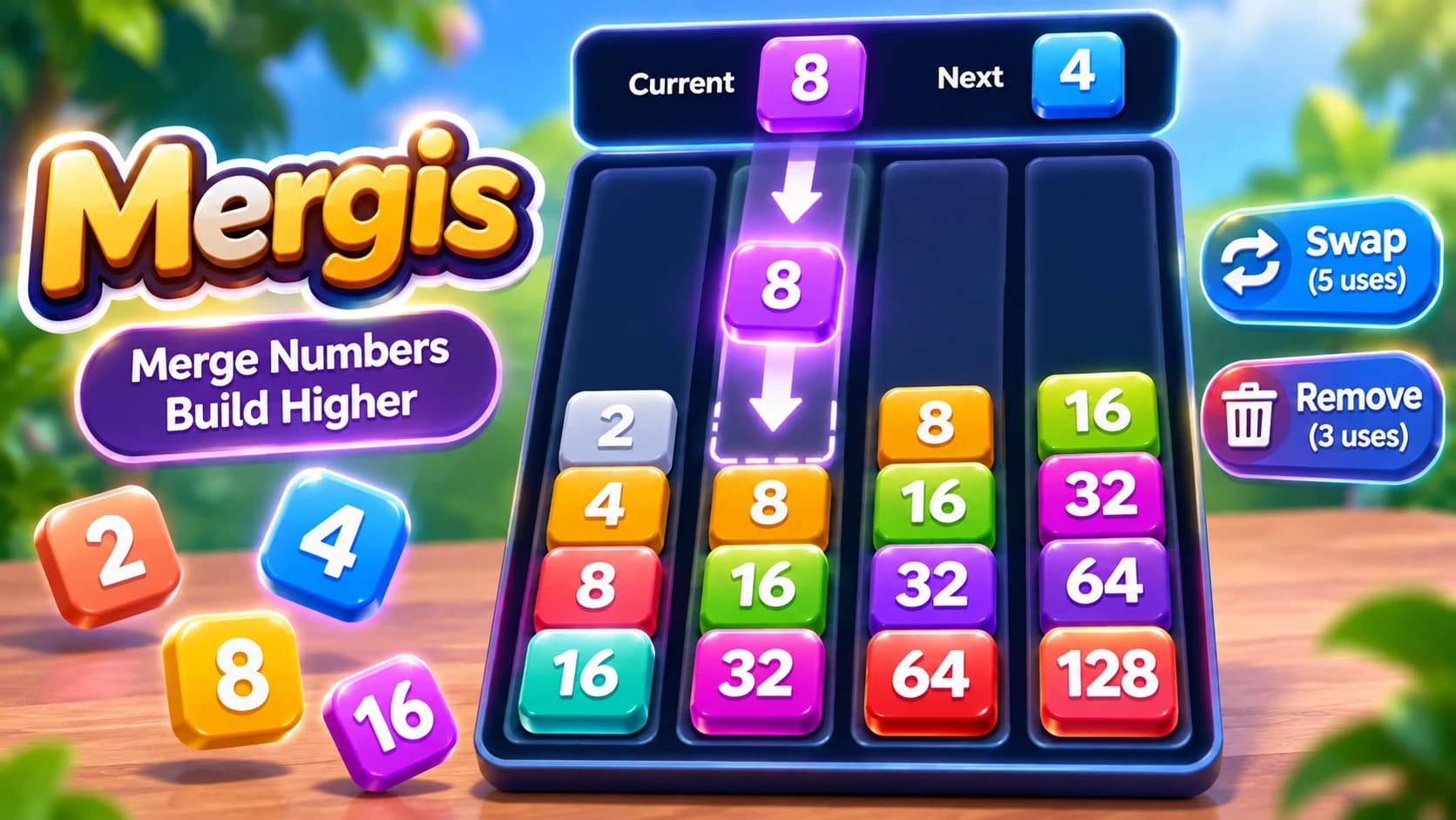
Drop the piece in your hand onto its match, and leave a lane open for the number coming next. Three Removes and five Swaps, and they are not refilled.
Table of Contents
Mergis gives you four lanes and one piece in hand. The panel also shows the piece after that. Each drop is a choice between two lanes: the one that matches what you are holding, and the one you are saving for the number that comes next.
Each lane holds eight pieces. A piece merges only with the same number directly under it, and the result is the next number up. If that result matches the piece under it, the lane keeps merging in the same drop. Numbers run from 2 to 16384. A 16384 stays as it is. It will not merge with another 16384.
New pieces start as 2s and 4s. That changes as your board grows. 8s start appearing once you have made a 32. 16s start appearing once you have made a 64. A lane topped with a 2 is a match for the early pieces and a dead top once the game is handing you 8s.
Which lane takes this piece
Read the next piece before you drop the one in your hand.
You are holding a 4, and an 8 is next. Drop the 4 on a lane whose top is 4 and whose next piece down is 8. The 4s become an 8, and that 8 matches the 8 beneath it and becomes a 16. One drop made two merges.
Leave any lane whose top is already 8. The next piece needs that top. Dropping the 4 onto that 8 covers the match, and the following turn has nothing to chain with.
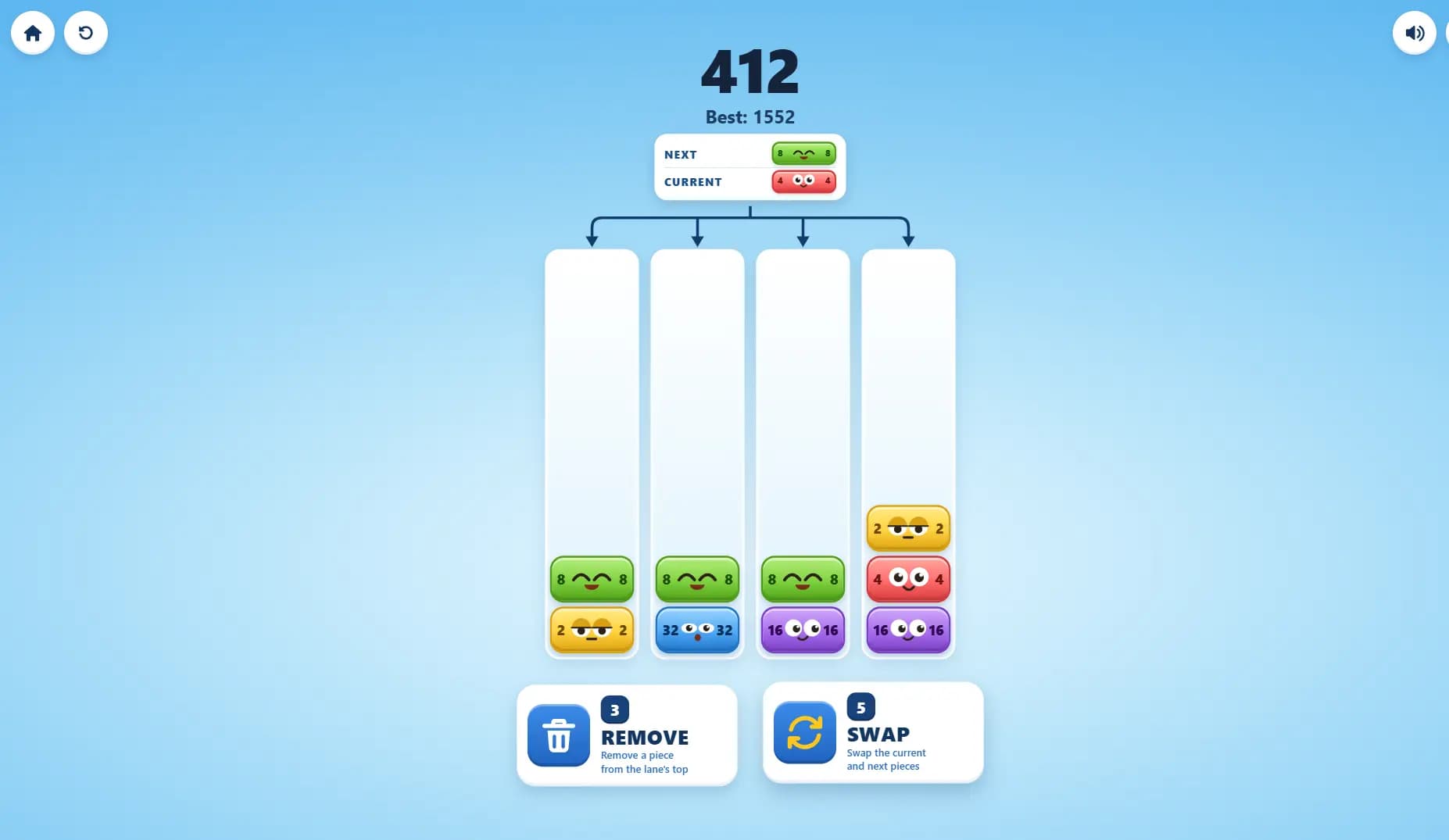
The piece in hand is a 4, and the lane shows a 4 with an 8 beneath it. That is the lane for this drop.
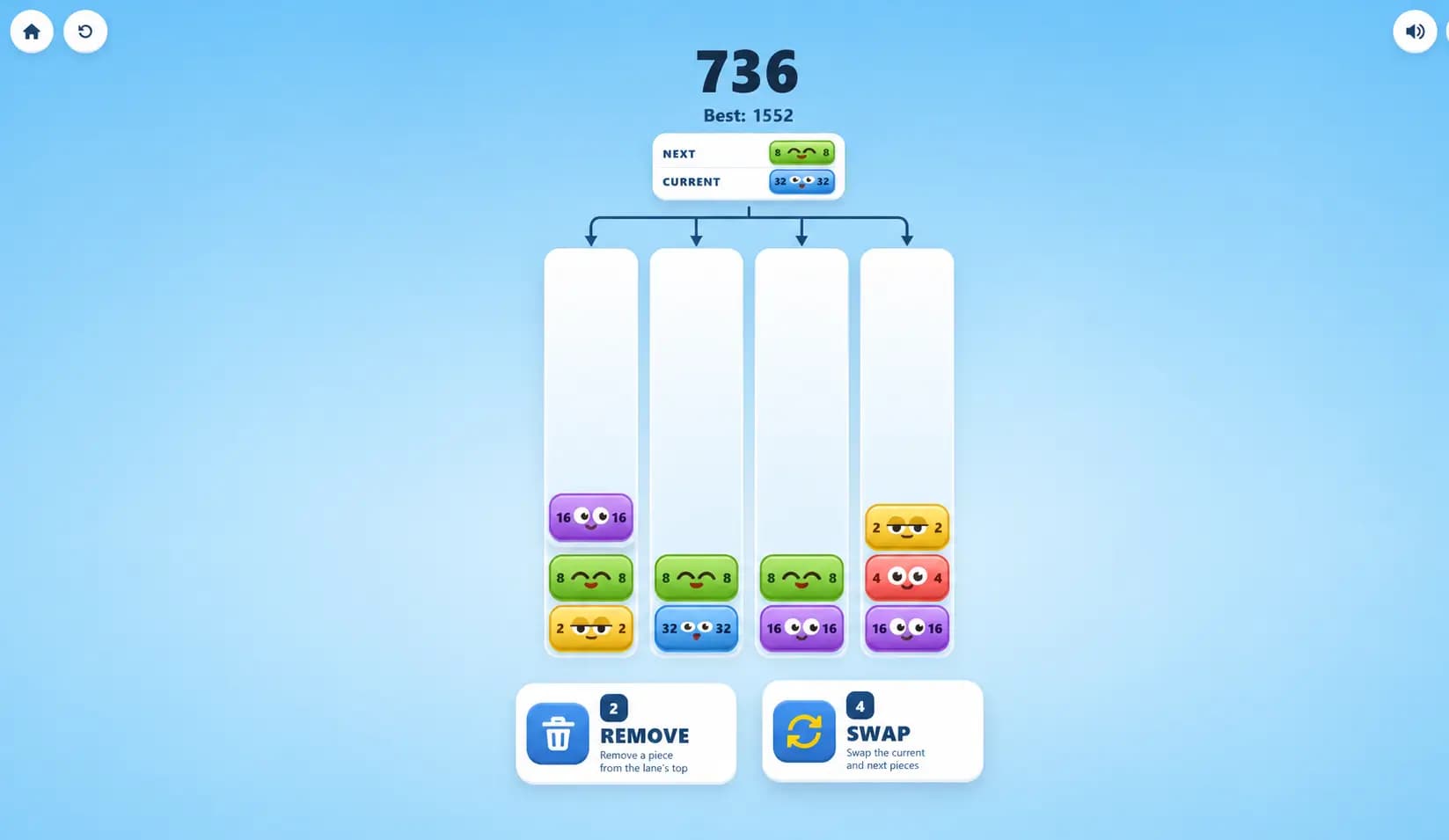
After the drop, that lane shows a 16. The lane you left topped with an 8 is still open for the next piece.
Keep each lane larger toward the bottom and smaller toward the top. A match on top can then roll down the stack. A 2 sitting on a 16 cannot start that roll. The 2 has to be built all the way up through 4 and 8 before it can meet the 16, and the lane only has eight spaces. Burying a large number under a 2 spends those spaces on a stack that will not move.
When the new pieces get bigger
While the panel is still dealing 2s and 4s, a lane topped with a 4 is useful on almost every turn. Keep at least one of those tops clear. The moment you make a 32, 8s join the pieces you are dealt. A lane that only offers a 2 or a 4 on top will not chain an 8. It will cover whatever was under it.
The same change happens again when you make a 64. 16s start appearing. A lane you left topped with an 8, which was the right save earlier, is now the lane an 8 can use and a 16 cannot. Look at the panel again after each of those milestones. The lane you were saving may be the wrong save for the new piece.
Swap is the tool for that moment. You have five Swaps for the whole game, and they are not refilled. Press Swap, or S, when the piece in your hand fits nowhere and the next one matches a top you kept open. Do not swap because the current piece is merely small. A 2 on a 2 is still a chain.
A full board
You have three Removes, also for the whole game. A Remove takes the top piece off one lane. Press Remove, then the lane, or press R, then 1, 2, 3, or 4.
Use one when a top is blocking a match you can see under it, or when every lane is full. If all four lanes are full and you still have a Remove, you have to use it. If you do not, the game ends. If all four are full and the Removes are already gone, the game ends anyway. Spending the three Removes while lanes still have empty space is how a later hand, with nowhere to drop, finishes the run.
A Remove is not a way to chase a higher chain. It throws the top piece away. Swap keeps both pieces and only changes which one you drop now.
Tap or click a lane. On a keyboard, 1, 2, 3, or 4 drops into that lane. On a phone, tap the lane.
What one chain scores
Each merge adds the new number, multiplied by its place in that drop. Two 2s that become a 4 score 4. If that 4 immediately becomes an 8 in the same drop, the second step scores 16.
The same two merges on two separate drops do not get that second step. The first drop scores 4 and stops. The later drop that turns a 4 into an 8 scores 8, not 16. A lane kept in order, so one drop can run down the stack, is worth more than the same merges spread across turns.
The best score stays in this browser until the site data on that device is cleared.
Before the next hand
The 4 fits two lanes. Which one? The one whose piece under the top will chain, and not the lane whose top matches the piece shown next on the panel.
An 8 just appeared and nothing matches it. You have made a 32, so 8s are now in the deal. Swap if the next piece is the one your open tops were saved for. Otherwise drop the 8 on a stack you are willing to cover.
Can I Remove a 2 just to tidy a lane? You can, and it costs one of three. Empty space under a messy top is still a place to drop. A Remove is for a top that is blocking a merge, or for a board with no empty lane left.
Does a 16384 start a chain? No. It stays a 16384. Building one in a lane that still had room for smaller chains spends that lane.
The score looked small for a long chain. The merges were on separate drops. Only merges in the same drop get the higher step. Two 2s that become a 4 and stop are worth 4, even if you merge upward on the next turn.
Open a game and name the lane the next piece needs before you place the one in your hand.
2048 merges matching tiles on a 4 by 4 board, and you can keep playing after the 2048 tile. A slide there moves every tile. A drop in Mergis chooses one lane.
More games are on Pokky Game.
Written by

Navinkumar Ahir
The studio
Navinkumar Ahir is a content creator and part of the team behind Pokky Game, a free online gaming platform featuring a wide variety of puzzle, arcade, racing, shooting, and sports games. He focuses on creating helpful gaming guides, tips, and strategies based on real gameplay, helping players discover new games, learn how to play, and overcome challenging levels. His goal is to make gaming simple, enjoyable, and accessible to everyone, with no downloads or account required.