How to Play Sumbreak: Tips and Strategies for Beginners

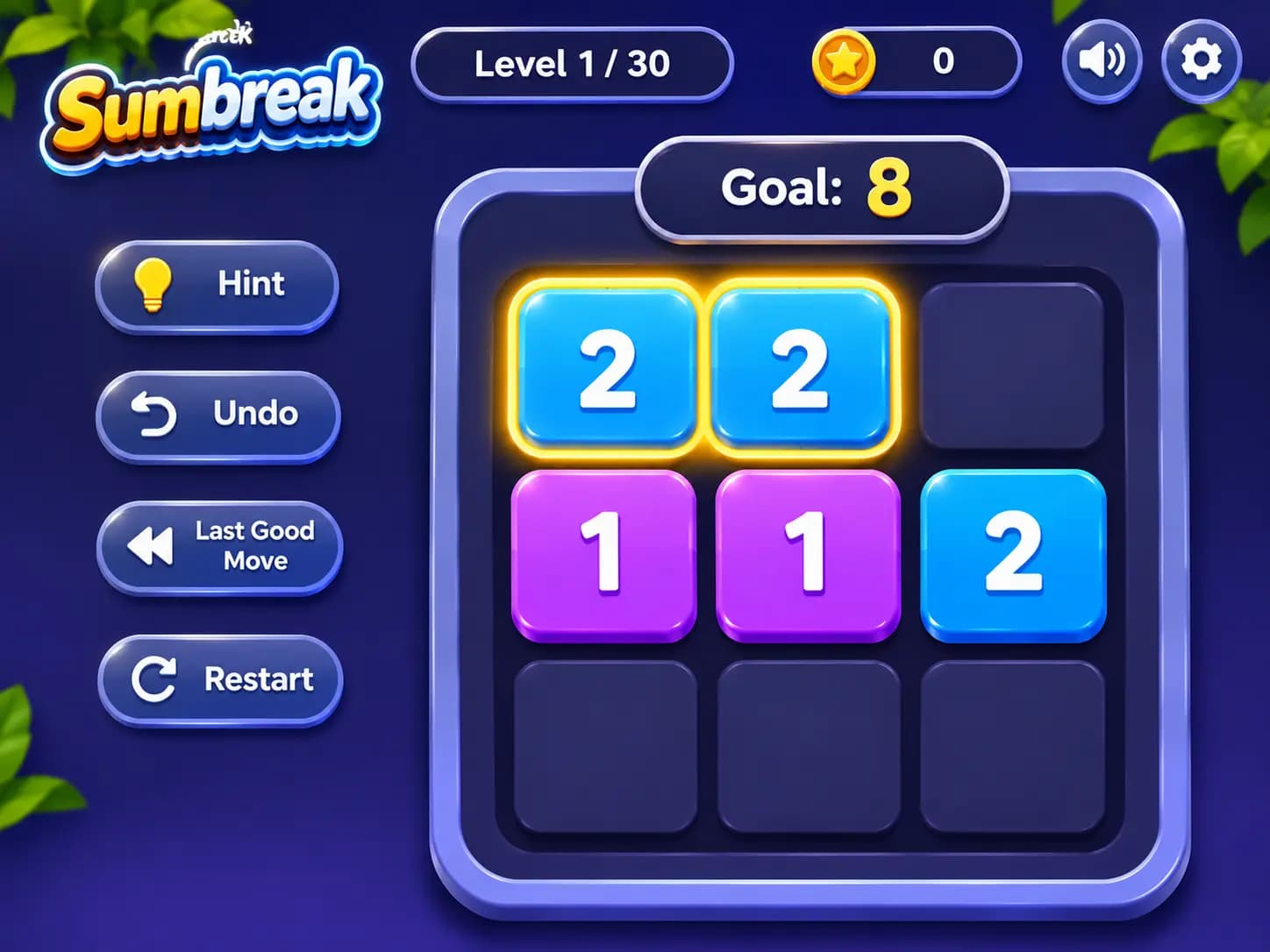
Drop a tile onto its twin and choose the cell the double stays in. A gap can split that pair for good.
Table of Contents
Sumbreak hands you a board that is already filled in. You do not draw new numbers, and a tile will not slide across a hole to reach its partner. The level is over when one number is sitting on the board and every other cell is empty.
The move itself is only a drop. You pick up a tile and put it on a neighbor that shows the same number. Those two tiles have to share a side. A corner touch does not count. The tile you create is worth double, and it stays in the cell you dropped on. The cell you picked it up from is empty after that, and it stays empty for the rest of the level.
There are 30 boards. The early ones are two tiles on a small 2×2. The later ones place sixteen tiles on a 4×4 or a 4×5, with holes already drawn into the grid. The level you have opened is saved on this device. You can close the browser and the same board will be waiting.
Why the number above the board never changes
Before the first drop, read the number shown over the grid. That number is every starting tile added together. A finished board has to show that number and nothing else. If you end on a different number, a second tile is still hiding somewhere, or a hole has already split a pair.
There is a simple reason the total does not move while you play. Two 2s become a 4, and 2 plus 2 is already 4. Two 4s become an 8, and 4 plus 4 is already 8. A merge replaces two tiles with their sum. The board’s total is the same before the drop and after it. You are not trying to build a high score. You are trying to gather that one fixed total into a single cell.
That makes a stuck board easy to spot. Suppose the number above the board is 8, and you are looking at a 4 and another 4 that do not touch. The values are right. The places are wrong. No later drop will carry one of them across the hole.
A row you can check with a finger
This row is a teaching line, not level 7 or any other numbered board. The cells read 2, then 2, then 4. Add them: 8. So the row is finished only when it shows 8.
First, put the left 2 onto the middle 2. The left cell empties. The middle cell becomes 4. The right cell is still 4. Those two 4s share a side, so the next drop is obvious. Put one 4 onto the other and the row shows 8. Two drops, and the number above the board matches the only tile left.
Now start the same row again and reverse the first drop. Put the middle 2 onto the left 2. The left cell becomes 4, the middle cell is empty, and the right cell is still 4. You did make a 4. The other 4 is still on the row. They do not share a side, and neither tile can step into the hole. The row is stuck on a 4 and a 4, even though they add up to the 8 you needed.
Both first drops were legal. Both made a 4. Only one of them left the next pair touching. Whenever two directions are allowed, drop toward the tile the new number still has to meet.
One merge on video
Instagram post
This post is hosted on Instagram. Loading it here connects your browser to instagram.com, which can receive your IP address and use its own cookies. Nothing is loaded from Instagram until you choose to.
Watch how the merged number stays in the destination cell after each move. The original cell becomes permanently empty, so choosing the correct landing direction is important. One wrong move can separate the new number from its next matching tile and make the board impossible to complete.
How a turn actually feels
Open Sumbreak.
On a computer, drag the tile onto the neighbor you want the double to land on. On a phone, tap the tile once to pick it up, then tap its twin. If you tap the wrong twin, you have already chosen the cell. Look before the second tap.
The keyboard does the same job in two steps. The arrow keys move a highlight around the board. Enter picks up the highlighted tile. The next arrow key merges it in that direction. It will only go if that neighbor matches. A diagonal key-press is not a direction the game allows.
H is the hint. It points at one merge that can still lead to a single tile. It does not glow on every matching pair. Another pair on the same board can be a dead end. Before you copy the hint, picture the cell the double would sit in. If that cell faces the next match, take it. If the hint’s pair can be dropped two ways, the hint has not chosen the way for you.
Three different controls take you backward. They are easy to mix up, and they do not do the same job.
U removes only the last merge. The rest of your drops stay. Use it the moment a drop opens a hole between two numbers that needed to meet.
Last good move reaches further. It returns the latest board from which one number can still be reached, which may be several drops ago. Use it when you have kept playing after the mistake and you no longer remember which single drop caused it.
R throws the attempt away and restores the tiles the level started with. Use it when the board is too tangled to unpick. It does not lock the level, and it does not wipe the other levels you have already cleared. Your place in the 30 stays on this device.
How to look at a large board
A 2×2 shows a bad landing at once, because there are almost no cells to hide in. A 4×4 or a 4×5 is the same rule with more holes. Treat a hole as a wall. You cannot fill it, park a tile on it, or cross it later.
Look in this order, and do it before every drop.
Find the pairs that already share a side. Ignore matching numbers that only meet at a corner. They are not a move yet.
For each real pair, imagine the drop both ways. One way leaves the new number beside the tile it still needs. The other way often leaves that same number on the far side of a hole. Take the first way.
If a 1 or a 2 on the edge still touches its twin, merge that pair before you build a large number in the middle. A small tile left on the rim, with an empty cell between it and its match, is the usual way a big board dies. You cannot carry it inward. The game will not deal a partner for it.
If neither direction of a pair keeps the next match touching, leave that pair alone and look at a different one. Merging them now makes a bigger number and also makes the board worse. Bigger is not the goal. The goal is the single total above the board, in one cell.
Every one of the 30 levels can be finished from the tiles it started with. A stuck board means a landing, not a level that has no answer. U, Last good move, or R puts you back on a board that still has one.
Questions players ask
These two show the same number. Why will they not combine? They meet at a corner, or a hole sits between them. The game only merges tiles that share a full side.
Can I nudge a tile into the empty square? No. Holes stay holes. No new tile falls in to plug one, on this level or the next.
I pressed H and the board still died. The hint found a pair that still had a path. The direction was still yours. Dropping the other way can place the double where that path no longer exists.
Did I fail the level? You failed the attempt. The level is still open. Step back with U if it was the last drop, use Last good move if you played on, or press R and see the first tiles again.
Does a new day wipe my levels? Not by itself. The 30 levels are kept in this browser on this device. Clearing the site data for Pokky Game, or switching browser, is what removes them.
The first grid
Open level 1 and look at the numbers on the board before making your first move.
Find two identical tiles that share a side. Remember that diagonal tiles cannot merge.
Before dropping a tile, check both possible landing cells. Choose the direction that keeps the resulting number close to its next matching tile.
After the first merge, look at the new board. Find the next matching pair and check whether the tiles can still reach each other without crossing an empty cell.
Continue merging while keeping future matching pairs connected. Avoid creating empty spaces between tiles that still need to merge.
If a move creates an unreachable pair, use Undo to reverse it. If you have made several incorrect moves, use Last good move to return to the latest board that can still be completed.
Keep checking the total above the board. It should remain unchanged throughout the level. Your objective is to combine all starting tiles into one final number.
More of the collection is on Pokky Game.
Written by

Navinkumar Ahir
The studio
Navinkumar Ahir is a content creator and part of the team behind Pokky Game, a free online gaming platform featuring a wide variety of puzzle, arcade, racing, shooting, and sports games. He focuses on creating helpful gaming guides, tips, and strategies based on real gameplay, helping players discover new games, learn how to play, and overcome challenging levels. His goal is to make gaming simple, enjoyable, and accessible to everyone, with no downloads or account required.