How to Play Ramp Riders: Tips and Strategies for Beginners

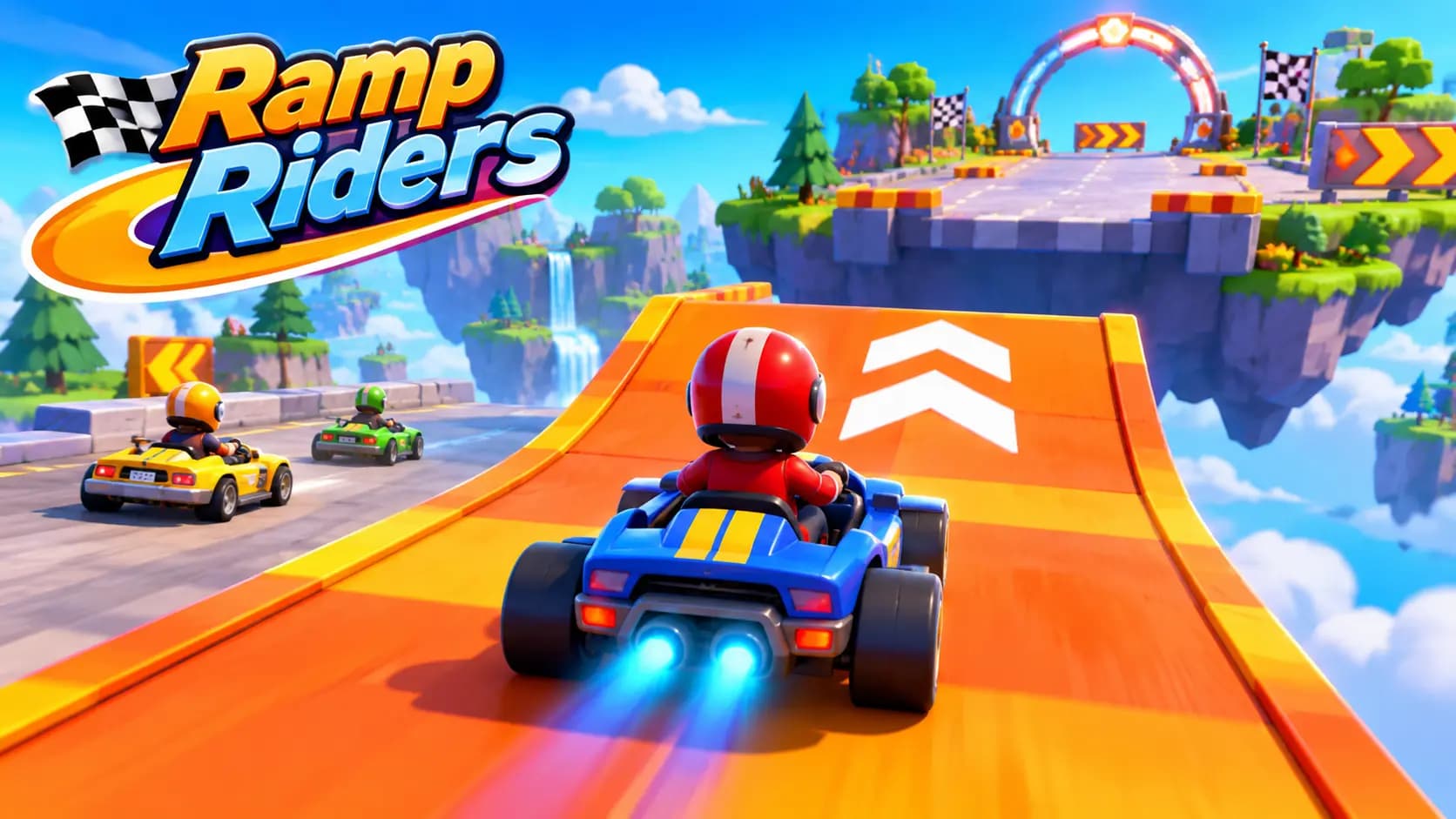
Hold the throttle into the orange ramp. Lifting before the gap drops the kart short, and a fall sends you back to the last checkpoint.
Table of Contents
Ramp Riders puts the kart on a narrow deck in the sky. Three to five rivals race the same kart, with the same physics and no catch-up help. A rival ahead took the ramps faster. That kart is not a quicker model.
Every hole in the deck is marked by an orange ramp just before it. The speed still on the kart when the wheels meet that ramp is what clears the hole. Lift, or ride the brake into the ramp, and the kart arrives slowly, then drops short of the far deck.
Twelve stages sit in three worlds, in this order: Sunset Bay, Cloud Yards, and Neon Heights. The gaps get wider, the deck gets tighter, and the ramps get steeper. A finish in the top three opens the next stage. First place is not required. The clock keeps the best time for each stage on this device, so a slow podium can be beaten later by a cleaner run of the same stage.
One ramp, from the straight to the landing
This is one jump, not a drawing of a numbered stage. The deck runs straight at an orange ramp, and the hole is on the far side.
Hold the throttle all the way onto the ramp. The jump was sized for a full-speed launch off the ramp in front of it. A hole that looks wide is not a reason to slow down. The slow arrival is the one that falls short.
Line the kart up on the straight, before the ramp is under the wheels. If the kart is crooked, the last correction belongs on the orange surface, while the tyres still have grip. The kart steers normally there. Once it leaves the ramp, the steering goes weak, and the throttle and brake do nothing. A wiggle over the hole will not straighten a bad takeoff. The landing was decided on the ramp.
If the kart drops in, it comes back at the last checkpoint you passed. The race is not over. You have lost the distance from that checkpoint back to the ramp, and you drive it again. The rivals do not stop and wait. They keep the time they have already made, which is why two falls on a short stage can cost a top-three finish even when the rest of the driving was quick.
The kart is still on the orange ramp, throttle held, with the gap in front of it.
Blocks, then the ramp
From the first stage, blocks are bolted across the deck. Each one leaves a corridor wider than a kart and a half, however far it sits, so a pass exists. Take it on the straight. In the air you cannot steer into a gap you missed.
The brake is for that straight. Down arrow or S slows the kart, and it also reverses, so you can settle beside a block and aim at the corridor. Let go of the brake before the orange ramp. Braking to “make the pass neat,” and still braking when the ramp starts, is the same mistake as lifting. You reach the jump with less speed than the hole was built for.
From the stage Bay Sprint, some blocks slide from side to side. The corridor is still wider than the kart. It moves. Watch one slide on the straight, then commit while the gap is on your line. Stopping next to a sliding block until it “looks safe,” then accelerating from a standstill into the ramp, turns a pass you could have made into a short jump.
What you are actually driving
Up arrow or W is the throttle. Down arrow or S brakes and reverses. Left and Right, or A and D, steer.
Space hops, and only on a keyboard. The pad in the corner of a phone is left, right, throttle, and brake. It has no hop. A phone run is won on the line into the ramp. Waiting for a hop that the screen does not have just lets the kart arrive late.
The clock, and a stage you already opened
There is no points total for a clean jump. The stage records time. A fall does not add a penalty number. It adds the seconds you spend driving the stretch again. A rival who never fell is not slowed down to let you back in.
Top three is the key to the next stage. After that stage is open, the best time is still the number on the clock. Start the stage again from the beginning. The rivals run the same kart from the start with you. They do not keep a lead from the attempt you just finished. A run with no falls replaces a podium that was full of checkpoints.
Sunset Bay is where the orange ramp and the fixed blocks are enough to learn. Cloud Yards and Neon Heights keep that jump and add less room to set the kart up before the ramp. Bay Sprint is the point where a block that used to sit still begins to slide, so the pass you took on memory in Sunset Bay has to be watched again.
Before the next stage
The kart fell. Is the race over? No. It returns at the last checkpoint. Only the drive back to the ramp is lost.
Why did the kart not turn over the hole? In the air the steering is weak, and the throttle and brake do nothing. The line is set on the ramp.
A rival is far ahead. Is that kart faster? No. Every kart is the same. That driver held the ramps and did not come back from a checkpoint.
Does the phone have the hop? No. Space hops on a keyboard only.
Does a top-three finish lock the time? It opens the next stage. The best time is still stored, and a later run of that same stage can beat it.
Open the first stage in Sunset Bay. Use the brake only to line up with a block, let it go, and hold the throttle onto the orange ramp. Straighten the kart before the wheels leave it.
Hill Dash is the other drive on Pokky Game. The car runs on a fuel tank over hills, and a landing on the roof ends the run.
More of the collection is on Pokky Game.
Written by

Navinkumar Ahir
The studio
Navinkumar Ahir is a content creator and part of the team behind Pokky Game, a free online gaming platform featuring a wide variety of puzzle, arcade, racing, shooting, and sports games. He focuses on creating helpful gaming guides, tips, and strategies based on real gameplay, helping players discover new games, learn how to play, and overcome challenging levels. His goal is to make gaming simple, enjoyable, and accessible to everyone, with no downloads or account required.